What feels different from one Carroll Gardens block to the next? Quite a bit, actually. If you are trying to understand how the neighborhood works day to day, the answer is not just about location on a map. It is about how the blocks themselves are built, where the retail corridors run, and how a few key public spaces shape your routine. Let’s dive in.
Carroll Gardens Is Not One Uniform Experience
Carroll Gardens reads as a compact neighborhood, but its daily rhythm changes block by block. Historic residential streets, busier mixed-use corridors, transit access, and park activity all create different experiences within a short walk.
That contrast is part of what gives the neighborhood its identity. According to the Landmarks Preservation Commission, the Carroll Gardens Historic District includes more than 160 buildings across roughly two very long city blocks, with tree-lined streets, low two- and three-story houses, and deep front yards that create an unusual amount of open space.
Residential Blocks Feel Buffered
Some of the clearest examples are President Street and Carroll Street within the historic district. The LPC describes them as dead-end streets, with Smith Street to the west and Hoyt Street to the east helping separate them from surrounding activity.
That layout can make these blocks feel more contained than a typical Brooklyn through-street. Instead of constant pass-through movement, the streetscape reads as more local and residential, shaped by rowhouses, front gardens, and a calmer street wall.
Deep Front Yards Change the Street Rhythm
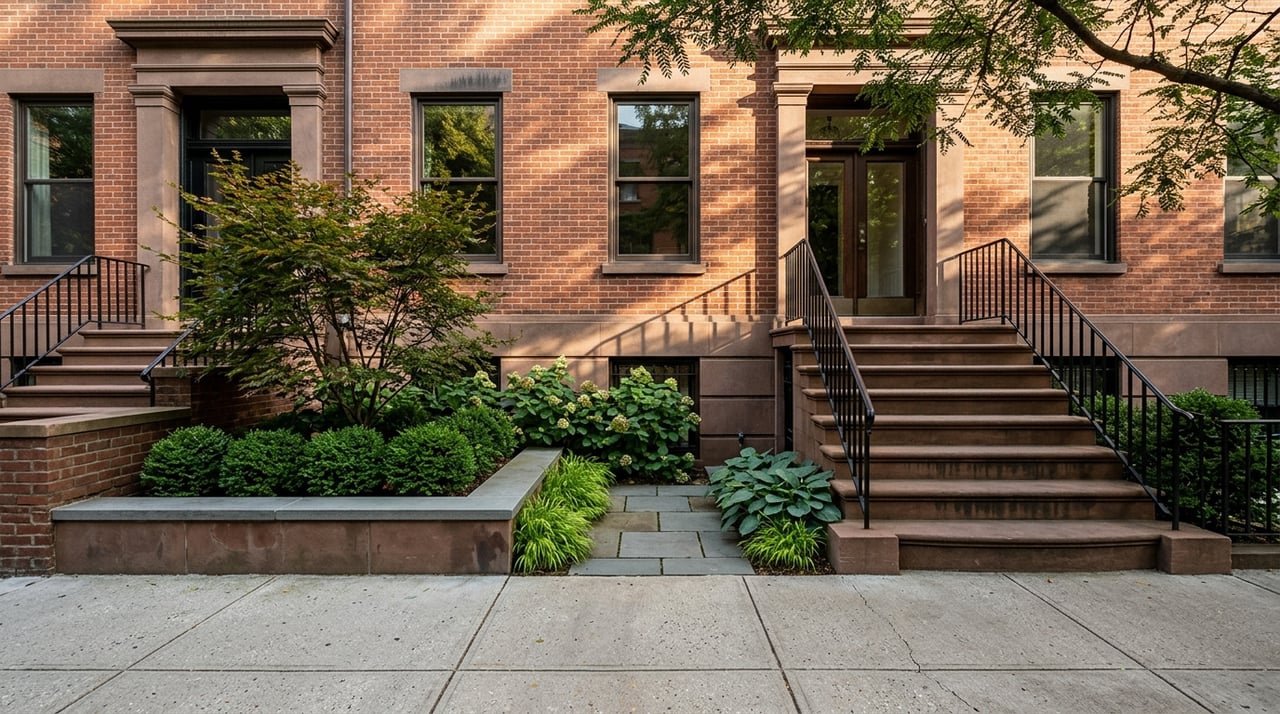
One of Carroll Gardens’ most recognizable physical features is its front-yard depth. Several east-west blocks were laid out with front yards of roughly 30 feet, which creates more breathing room between buildings and sidewalks than you see in many other dense Brooklyn neighborhoods.
The city later reinforced that pattern. In 2008, select blocks were designated as narrow streets so that new construction would better match the existing built context, according to the City Planning Commission.
Open Space Feels Built In
That front-garden pattern does more than change appearances. It affects how the street feels when you walk it. With low-rise homes, trees, and deeper setbacks, the public realm can feel quieter and more open than the tighter edge condition you get on many city blocks.
For buyers and sellers, this matters because built form often shapes daily comfort as much as square footage does. In Carroll Gardens, block design plays a direct role in privacy, light, and the general sense of pace.
Smith and Court Streets Carry Daily Activity
If the interior residential blocks feel quieter, Smith Street and Court Street do much of the neighborhood’s visible daily work. The City Planning Commission describes both as main retail corridors lined with three- and four-story mixed-use buildings, with commercial or community uses at ground level and residences above.
These are the blocks where errands, transit, and everyday movement tend to concentrate. They absorb more foot traffic, more deliveries, and more of the neighborhood’s back-and-forth motion.
Smith Street Connects Shopping and Transit
Smith Street is especially important because it combines retail activity with subway access. The F and G trains run under Smith Street, and Carroll Street station sits in the heart of the neighborhood. Nearby Bergen Street and Smith-9 Sts stations also support the area’s walk-to-transit pattern.
That transit placement helps explain why daily life can feel efficient here. A short walk can connect you to stores, services, and the subway without requiring the same pace or scale of activity on every residential block.
Court Street Works as a Movement Corridor
Court Street is not just a shopping street. NYC DOT describes it as a busy mixed-use corridor through Carroll Gardens, and in 2025 the agency redesigned it with a parking-protected bike lane, shorter pedestrian crossings, and pedestrian islands.
That combination matters because it shows how one corridor can serve several roles at once. Court Street supports storefront activity, but it also helps move cyclists, walkers, and local traffic through the neighborhood more safely and efficiently.
The Shift Between Blocks Is the Point
One reason Carroll Gardens stands out is the contrast between its residential interiors and commercial edges. Within a few blocks, you can move from a front-garden rowhouse street to a busier corridor with shops, train access, and more visible circulation.
That change is not random. It is a direct result of the neighborhood’s physical structure: quieter side streets, stronger commercial spines, and public spaces that anchor recurring routines.
Carroll Park Adds a Reliable Center
Carroll Park helps organize neighborhood life in a different way. NYC Parks identifies it as a 1.87-acre neighborhood park and playground at Smith, Carroll, and President Streets.
Because of where it sits, the park acts like a shared point between residential and commercial activity. It is close enough to the neighborhood’s busier blocks to stay active, but still embedded in the local street grid.
The Greenmarket Shapes Sunday Routine
GrowNYC’s Carroll Gardens Greenmarket takes place year-round every Sunday on Carroll Street between Smith and Court, alongside Carroll Park, and has connected local farms with neighborhood residents since 2007.
That recurring setup gives the surrounding blocks a different weekend rhythm than they have during a standard weekday. Shopping, strolling, and park use overlap in one small area, creating a predictable weekly pattern that many residents can build into their routines.
Daily Life Works in Short Distances
Taken together, Carroll Gardens functions as a neighborhood of contrasts rather than a single uniform setting. Historic side streets offer a calmer residential feel, while Smith Street and Court Street concentrate retail, transit, and movement. Carroll Park and the Sunday Greenmarket add regular gathering points that bring another layer to the local routine.
For anyone thinking about buying or selling here, that block-by-block variation matters. Two homes that sit only a few streets apart can offer noticeably different day-to-day experiences based on frontage, street type, and proximity to transit or commercial activity.
That is why neighborhood knowledge needs to go beyond a broad label. In Carroll Gardens, the details of the block often shape how the area actually lives.
If you are thinking about buying or selling in Carroll Gardens or nearby South Brooklyn neighborhoods, DE Advisory Team can help you evaluate not just the address, but how the block, built context, and property condition may affect value and daily use.
FAQs
How do Carroll Gardens residential blocks feel different from commercial streets?
- Residential blocks in the historic district are defined by low-rise rowhouses, tree-lined streets, and deep front yards, while Smith Street and Court Street carry more retail activity, foot traffic, and transit movement.
Why are front gardens important in Carroll Gardens?
- Several east-west blocks were laid out with roughly 30-foot-deep front yards, which creates more open space between homes and sidewalks and contributes to a more buffered street feel.
Which streets are the main retail corridors in Carroll Gardens?
- Smith Street and Court Street are the neighborhood’s main retail corridors, with mixed-use buildings that combine ground-floor commercial or community uses with residences above.
How does transit shape daily life in Carroll Gardens?
- The F and G trains run under Smith Street, with Carroll Street station in the neighborhood and nearby Bergen Street and Smith-9 Sts stations supporting a walk-to-transit routine.
What role does Carroll Park play in Carroll Gardens?
- Carroll Park serves as a neighborhood park and playground near Smith, Carroll, and President Streets, helping anchor daily and weekend activity in the area.
When is the Carroll Gardens Greenmarket open?
- The Carroll Gardens Greenmarket runs year-round every Sunday on Carroll Street between Smith and Court, next to Carroll Park.