Why did the average Crown Heights home take 126 days to sell in February 2026, more than double the 51 days it took the year before, while brownstones inside the neighborhood's historic districts kept closing in under two months with multiple offers on the table?
Both numbers are real. Both describe the same few square miles. The gap between them is the actual story this year, and it matters more to someone comparing Crown Heights against another South Brooklyn neighborhood than any single median price pulled off a portal.
Crown Heights isn't cooling and it isn't overheating. It's splitting into two markets that happen to share a name: a broad, slower pool of ordinary listings sitting for months, and a narrow, fast-moving pool of landmarked private homes that barely reach the open market before they're gone. If you're weighing Crown Heights against Cobble Hill or Bed-Stuy or anywhere else, the question worth asking isn't "what's the median," it's "which of these two markets would I actually be shopping in."
The slowdown you can see from the outside
The headline numbers on Crown Heights look like a market losing steam. A neighborhood tracker showed the median sale price at $1.2 million in February 2026, up sharply year over year, but paired that with an average of 126 days on market, compared with just 51 days the February before. Sales volume told the same story: 27 homes changed hands that month, down from 45 a year earlier. A separate February snapshot of houses currently listed put the median closer to $848,000 with an average of 125 days on market, and only nine detached houses for sale across the entire neighborhood at that moment, ranging from $979,000 to $4.495 million.
Those two trackers don't agree on the exact median because they're measuring different slices of the market, sold prices across all property types versus currently listed detached houses. But they agree on the shape of the thing. Days on market roughly doubled. The number of homes actually trading kept shrinking. On paper, that reads like buyer demand pulling back.
It isn't. It's the visible half of a market that's quietly running two different clocks.
The other half never really shows up as a listing
A separate look at Crown Heights private home sales this year describes something closer to a scarcity spiral than a slowdown. Well-priced private homes were reported moving roughly 15 percent faster than the broader market, with the negotiation window on premium assets compressed to under 55 days. Much of that inventory isn't arriving through a normal 90-day marketing campaign at all. It's arriving through estate liquidations and off-market transfers, the kind of sale triggered by inheritance or a life event rather than a homeowner deciding to test the market. When one of those properties does surface, it's often the only comparable asset available, and it draws immediate multiple-offer competition.
Two independent 2026 market projections, one focused on Crown Heights specifically and one covering Brooklyn borough-wide, landed on nearly the same forecast for where this is headed: townhouse values climbing toward roughly $1.45 million by late 2026, with typical home values in the $1.25 million to $1.35 million range. That kind of convergence from unrelated sources is worth taking seriously, and it points to the same mechanism both times. The properties buyers actually want aren't sitting on a shelf getting price cuts. They're barely making it to the shelf.
Why landmarking is the real supply story
The reason this specific pocket of Crown Heights behaves differently than the neighborhood average isn't mystery. It's zoning history.
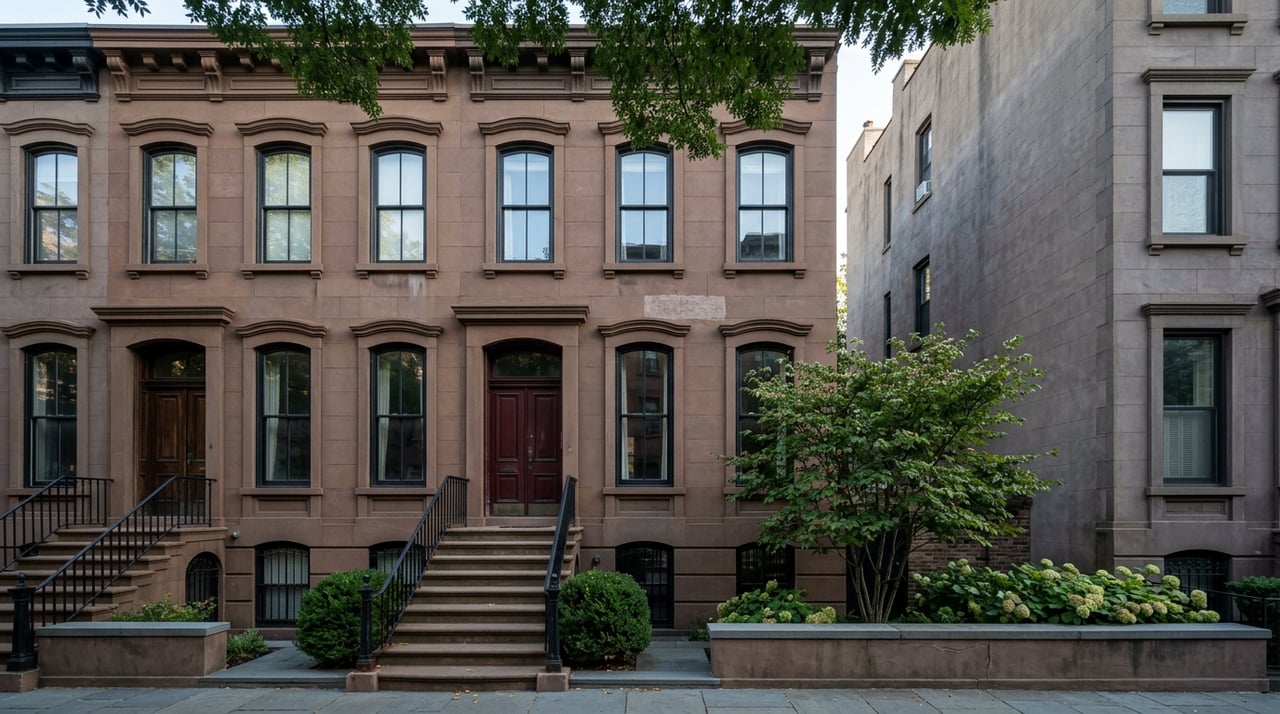
The Crown Heights North Historic District was designated by the Landmarks Preservation Commission on April 24, 2007, protecting more than a thousand buildings, mostly rowhouses, freestanding villas, and flats built between roughly 1853 and 1942. The district's footprint grew further in 2016, when its National Register listing was expanded to cover more than 600 additional buildings, including several tied to the residences of Shirley Chisholm, the first African-American woman elected to Congress. A second, adjacent district, Crown Heights North II, was designated on June 28, 2011, adding more than 600 more buildings in the area roughly bounded by Bergen Street, Eastern Parkway, Brooklyn Avenue, and Nostrand Avenue.
The protected footprint hasn't stopped growing. As recently as 2023, the Crown Heights North Association, which has helped secure landmark protection for roughly 1,600 buildings over the past sixteen years, was actively pushing for a further extension near Crow Hill, including a set of quiet blocks between St. Johns and Lincoln Place that don't connect to any major avenue, and a stretch of St. Marks Avenue lined with buildings designed by the architect George P. Chappell.
Here's what that means for a buyer's math. Any exterior change inside a historic district, a stoop repair, a window replacement, a rooftop addition, needs Landmarks Preservation Commission approval before it happens. That slows renovation timelines and narrows what an owner can do without a public review process. But it also means this housing stock can't be replicated. A developer can't build a new version of a Renaissance Revival rowhouse on Dean Street the way they can build a new condo tower somewhere else in the neighborhood. When a legacy owner in one of these districts finally sells, usually because they have to rather than because they want to, there's no manufacturing more of what just came onto the market.
That's the mechanism behind the two clocks. Ordinary listings across the wider neighborhood compete with each other and with new construction, so they sit longer when priced ambitiously. Landmarked stock inside a shrinking, protected footprint doesn't have that competition, and it moves the moment it appears.
Three markets are hiding inside that one median
There's a second layer worth understanding before you trust any single Crown Heights statistic. An April 2026 snapshot showed the median house price at $1.8 million, down 13.1 percent year over year, while the median condo price jumped 75.7 percent to $1.3 million and the median co-op price ticked up 6.3 percent to $340,000. Only thirteen properties traded that month across all three categories combined.
A swing that large off a base that small isn't a trend. It's arithmetic. With thirteen sales split across houses, condos, and co-ops, one new-development condo closing at a premium price can swing the "median condo" figure as much as any actual shift in buyer appetite. The next month could just as easily swing the other way. Before reacting to a dramatic year-over-year percentage attached to any Brooklyn neighborhood this thin on transactions, it's worth asking how many sales that percentage is actually built on.
What the split does tell you honestly is which product type you're competing for. A house purchase in Crown Heights right now means competing for a shrinking, often off-market pool inside a landmarked district. A condo purchase means competing in a smaller but more volatile new-development lane where a single large closing can move the whole average. A co-op purchase sits in a different price tier entirely and moves at its own pace.
What this means if you're comparing neighborhoods
If your plan for finding a Crown Heights townhouse depends on the national mortgage rate lock-in effect finally breaking, the one that's been keeping owners with 2020 and 2021-era sub-3 percent rates from listing, it's worth knowing that effect is expected to ease unevenly. A national survey of real estate agents conducted in the spring of 2026 found the Northeast still running as one of the tightest seller's markets in the country, even as parts of the South and West loosened. Crown Heights sits inside that tighter Northeast pocket, and its scarcest stock is scarce for two overlapping reasons, not one: rate lock-in on the ownership side, and a historic district boundary on the supply side that keeps expanding rather than shrinking. Waiting for national headlines about easing inventory to translate into more landmarked brownstones hitting the market in this specific neighborhood is a bet against both trends at once.
If that's the property type you actually want, the practical move is positioning yourself to act inside a 55-day window with financing ready, rather than expecting a leisurely 125-day search. That's also where having someone who understands both the appraisal math and the construction realities of a century-old, landmarked building earns its keep, since these homes come with LPC approval timelines and renovation constraints that a standard comp sheet won't show you.
FAQ
Does landmark designation hurt a home's resale value? Not based on what the data here shows. Exterior changes need Landmarks Preservation Commission approval, which adds time to renovation projects, but the same protection is what's kept this stock from being replaced by new construction, which is a meaningful part of why it holds a scarcity premium relative to the rest of the neighborhood.
Will Crown Heights inventory loosen as the national lock-in effect eases? Possibly for the broader pool of ordinary listings, the ones currently sitting closer to 125 days. The landmarked, historic district stock is constrained by preservation rules and often by estate timing rather than rate decisions alone, so it's reasonable to expect that pool to stay tight even if the wider market loosens.
What's the practical difference between "Crown Heights" and "Crown Heights North" in a search? Crown Heights North and Crown Heights North II are specific, mapped historic districts, roughly the area between Atlantic Avenue and Eastern Parkway on one side and Bergen Street and Eastern Parkway on the other. Searching within those boundaries versus the broader Crown Heights label will surface a meaningfully different set of properties, with different renovation rules attached.
If you're trying to figure out which of these two Crown Heights markets your own property or search actually belongs to, that's exactly the kind of question worth working through with someone who reads the data past the headline number. DE Advisory Team combines hands-on Brooklyn sales experience with construction and appraisal background, and we're happy to walk through what your specific block, block type, and timeline actually mean before you list or make an offer. Request a home valuation and let's look at the real comparables, not just the median.