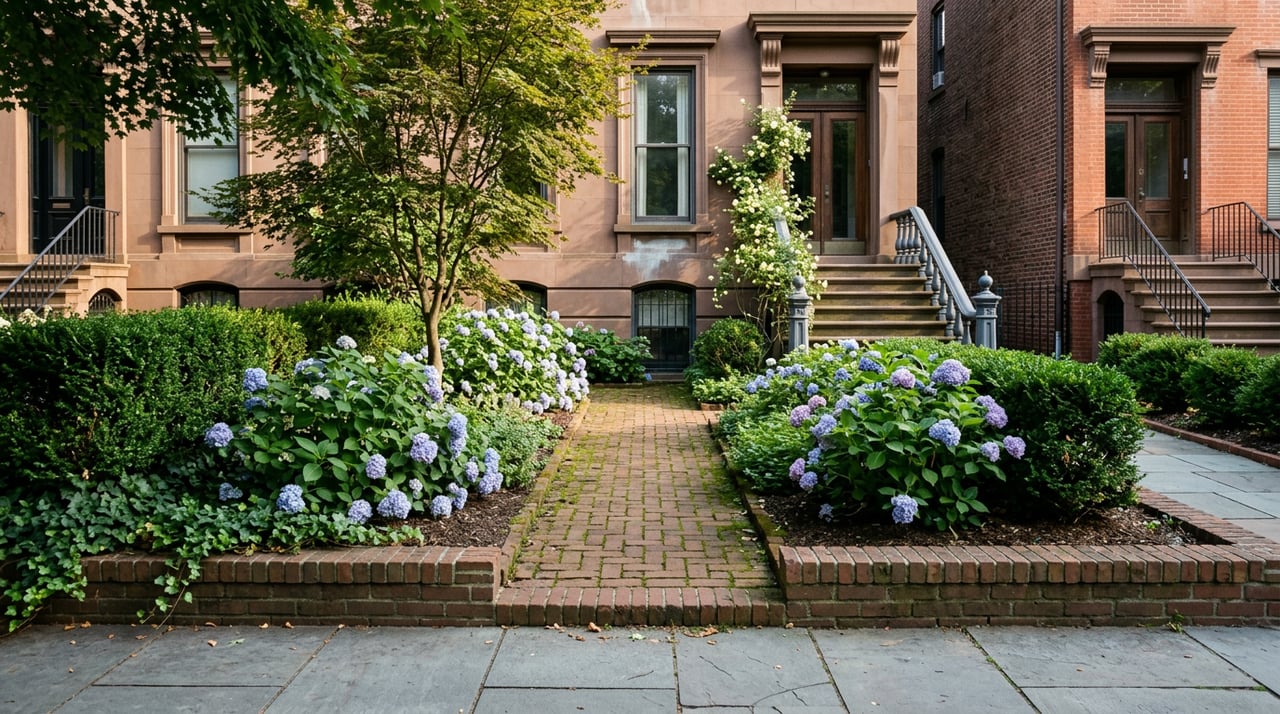
Walk down President Street between Smith and Hoyt on a August evening and the neighborhood's namesake is doing exactly what it's supposed to do. Hydrangea spilling over cast iron. Rose canes reaching the second-floor sill. Thirty-some feet of planted yard between the brownstone stoop and the sidewalk, more breathing room than almost anywhere else in brownstone Brooklyn. It's the view every guide to the neighborhood leads with, and it earns the attention.
But nobody is sitting in those gardens. They're private, fenced, and owned by the household behind them. You can admire one from the sidewalk. You cannot pull up a chair. If you want to know where Carroll Gardens actually spends a summer evening together, you have to walk two blocks toward Court and Smith, to a park that's smaller than it sounds and busier than it looks.
A Law That Built a Look, Not a Living Room
The deep front yards exist because of a specific decision made in 1846, when surveyor Richard Butt drew up the street plan for the blocks between Henry and Smith Streets and required a 33-foot-5.25-inch setback between the house line and the street. That single measurement is why the Carroll Gardens Historic District, designated by the Landmarks Preservation Commission in 1973 and covering roughly 130 to 160 rowhouses, looks the way it does. Neo-Grec and Italianate brownstones, each with its own strip of garden out front, none of it shared.
It's a beautiful piece of 19th-century zoning. It is also, by design, private. The setback gave Carroll Gardens its look. It didn't give the neighborhood anywhere to gather.
The Two Acres Doing All the Work
That job falls to Carroll Park, a parcel bounded by Court, Smith, Carroll, and President Streets that started as a private garden in the late 1840s before the city bought it about a decade later, making it one of Brooklyn's three oldest parks. Current city parks records put the whole site at 1.87 acres. For comparison, that's smaller than a city block. And on any given week from June through August, it's asked to do the work of a much bigger space.
| What's happening | When | What to bring |
|---|---|---|
| Bocce courts | Year-round, first-come-first-served | Your own balls, no permit needed |
| Summer concerts | Select Sundays, June through August, 5 to 6:30 p.m., South Parkette | Blanket or chair, cash for the tip jar |
| Shakespeare in the park | Late spring into early June | A blanket, since the ground is mostly cement |
The bocce courts alone are a small piece of New York history. City parks documentation notes there's no permit required and no ball rental, which means the neighborhood's Italian-American families and newer arrivals alike show up with their own sets and just start playing, a tradition that traces back to the early 1900s and has made Carroll Park one of the two best-known free public bocce courts in the five boroughs, the other being McCarren Park on the Williamsburg-Greenpoint line. As of this month the courts are still doing exactly what they've done for over a century: first-come, first-served, no reservation, no fee.
An Institution the Park Made, Not Just Hosted
The clearest evidence that this two-acre park punches above its footprint is what it's grown inside its own boundaries. Smith Street Stage started in 2010 as a five-actor production of Romeo and Juliet, funded by a Shakespeare trivia night. This year marked the company's 16th season of free outdoor Shakespeare in Carroll Park, with a run of Julius Caesar from May 16 through June 7, timed deliberately to the run-up to the country's 250th anniversary. The company sets up 100 folding chairs each night, and by the accounts of people who've gone, those chairs get taken fast, especially toward the end of a run. Bring your own seating if you want to be sure of a spot.
That run wrapped in early June, so by mid-August the folding chairs are packed away until next spring. But the company itself has outgrown its origin story enough to add a second annual production, now staged at the Mark O'Donnell Theater in downtown Brooklyn. A neighborhood park with fewer than two acres incubated a theater company that now needs a second venue. That's not something you can say about the front gardens, however good they look from the street.
The Overflow Parks
Carroll Park isn't carrying this alone. A few blocks over, DiMattina Playground has a softball diamond that keeps local leagues busy through the summer, with a dog run tucked just past the outfield for anyone whose evening plans involve a leash rather than a bat. And at St. Mary's Playground, in the shadow of the elevated subway platform on Smith Street, a sprayground draws kids through the warmer months, the kind of low-key infrastructure that doesn't photograph as well as a front garden but gets used a lot more often.
None of these are gardens in the sense the neighborhood's name suggests. They're small, functional, occasionally concrete-heavy public parks, and together they're doing the job that all that celebrated private greenery was never built to do.
Late August, Specifically
Right now, in the middle of August, the split is easy to see if you know where to look. The front gardens are at their heaviest bloom of the year, hydrangea and rose at their peak before the first cool nights start to fade them back. The bocce courts are still open with no line to check in, because there's nothing to check in for. Carroll Park Association's concert series still has at least one more Sunday evening on the calendar this month, and one of those August dates comes with free ice cream for anyone who shows up. The Shakespeare chairs, meanwhile, are in storage until next May.
The neighborhood's name describes what you see walking down the block. Its actual summer, the version where people sit down, play a game, watch a show, or let the dog off leash, runs on a couple of unglamorous acres that nobody put on a postcard.
If you're thinking about your own place in a neighborhood built around this kind of detail, whether that means facade work inside the historic district's review process or simply understanding what a listing near the park is really worth, the DE Advisory Team works these blocks year-round and can walk you through it. Request a Home Valuation when you're ready to talk specifics.